This novel smells like rain, soil, and old letters. It is sad, but never hopelessly so.
MY STUDY PRESENTS
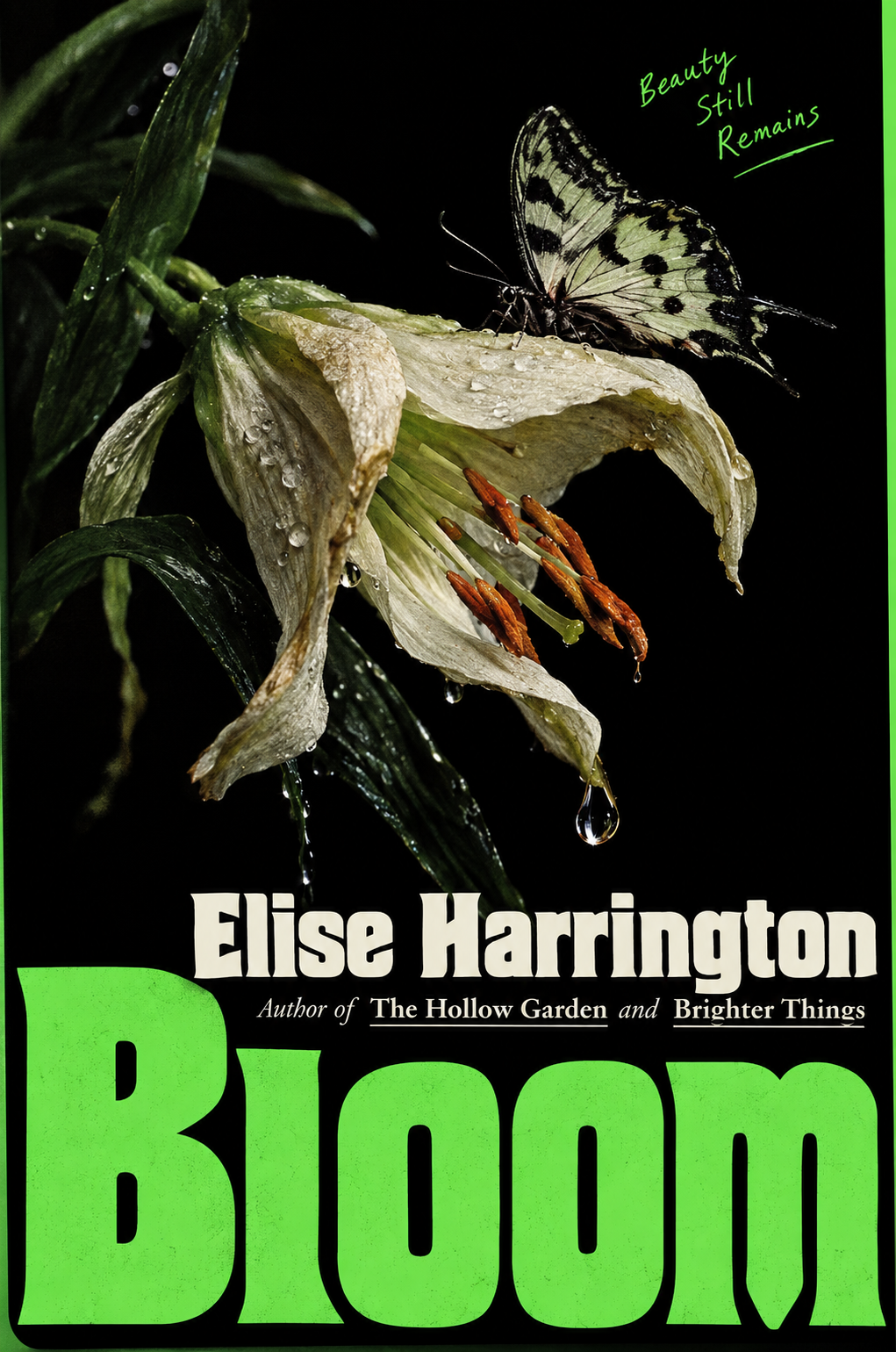
Bloom
MOODYSTRANGENATURE
DEMO READER / BLOOMREAD NOW →
01 / THE VIBE
🌿 GARDENS🦋 NATURE🩸 TRANSFORMATION🖤 OBSESSION
Elise Harrington is an Irish-British novelist whose work moves between gothic fiction, family drama, and nature writing. Born into a family of botanists, she spent much of her childhood in greenhouses, old estates, and by the sea before studying art history in Dublin. Harrington’s novels often follow things that continue growing after death: plants, memories, family secrets, and love that refuses to stay buried. Her prose is delicate and quiet, yet unsettling details hide inside its gentlest scenes. Bloom continues her fascination with nature and death and is her first novel centered on an abandoned botanical garden.
Plant conservator Clara Wren has not been home in seven years. After her sister Rose died, she had even less reason to return. Then her father dies, leaving an unusual condition in his will: Clara must live alone for forty-nine days inside the family’s abandoned glasshouse before she can inherit the land. The greenhouse has been neglected for years. Its glass is broken, vines have invaded the walls, and every lily is dead. Yet on Clara’s third day there, a white lily blooms in the middle of winter. A butterfly rests on its petals. It belongs to the same species Rose studied before her death—a species long extinct in the area. Every morning after that, another flower opens. Stranger still, each one corresponds to a memory the sisters shared: the tree hollow where they hid things as children, the first time Rose ran away, their final argument by the lake. Clara begins to suspect that her father left her not an inheritance, but a route to follow.
Following the order of the flowers, she finds letters Rose never sent and slowly discovers that her sister’s “accidental death” was not as simple as the police decided. A third person was present during the summer everyone insists is over. And her father knew his name. On the forty-eighth day, the final lily rises in the center of the greenhouse. It does not bloom. Clara knows it will open only when she finds the place where Rose truly died. Some things wilt because life has ended. Others refuse to bloom because the truth has not yet been brought into the light.
you've been warned ↘
Don’t just take
our word for it
Bloom isn’t really about death. It’s about how you keep loving someone who is no longer here.
I actually cried when the final lily opened. Not from a twist—just a very quiet kind of heartbreak.
GET A TASTE!
Clara found the lily on the fourth morning. The temperature had dropped to three degrees below freezing overnight, and a thin sheet of ice covered the glass on the north side of the greenhouse. She knew she had checked the central flower bed before going to sleep. There had been nothing there but black soil, dead roots, and an overturned terracotta pot. Yet at sunrise, a white lily stood in the middle of it. It was not beautiful, at least not with the flawless beauty of a florist’s display. The edges of its petals had yellowed like an old letter soaked in water. Its stem bent to one side, and tiny beads of moisture covered the leaves. Still in her pajamas, Clara crouched before it and touched the earth. The soil was wet. It had not rained overnight, and the roof had not leaked. She pushed her fingers deeper and felt something hard in the cold earth. At first she thought it was a stone. When she dug it free, she found a silver hair clip set with a blue glass bead gone dark with age. She knew it. When Rose was twelve, she wore two identical clips every day. She once lost one and cried the entire afternoon. Their father said it must have fallen into the lake. Their mother said it was cheap and they could buy another pair. Only Clara knew why Rose cried. They had fought in the greenhouse that morning, and Clara had torn the clip from her sister’s hair herself. She sat in the dirt and suddenly heard the beat of wings. A butterfly landed on the lily, its wings gray-white with four black marks at the edges. Clara’s body recognized it before her mind did. Parnassius mnemosyne. Their father called it the memory butterfly. The last recorded sighting in the county had been nineteen years earlier—the year Rose died. Clara did not move. Neither did the butterfly, as if they were waiting for one another. Then it opened its wings, rose from the petals, circled Clara once, and flew toward the far end of the greenhouse. Wooden crates were stacked there, boxes their father had forbidden anyone to touch while he was alive. Clara followed and watched the butterfly settle on the top lid. The lock was rusted. She struck it three times with her garden shears before it broke. There were no tools or seeds inside, only dozens of letters tied with a faded blue ribbon. The top envelope bore her name. The handwriting was Rose’s. Clara stared at it for a full minute without breathing. The date in the top corner was August 14, 2007—six days after Rose’s body was found beside the lake. At last Clara turned it over. A tiny line had been written on the back, as if the writer had changed her mind at the final second.
CONTENT NOTES
01WHY WE PICKED THIS BOOKBloom turns the grief of losing someone into a greenhouse flowering again: tender, rain-soaked, and hiding a secret that has waited years to be found.
02A QUICK HEADS-UP🌿 Slow and deeply atmospheric; themes include bereavement, grief, and family secrets, though this is not purely a horror story.
03WHO IT'S FORFor readers who love botanical imagery, gothic estates, sisterhood, gentle healing, and literary mystery.
SIMILAR BOOKS